From Material Breakthroughs to Industrial Applications: eSUN’s R&D Journey in PLA 3D Printing Materials
From establishing its PLA biomaterial industrialization strategy in 2002, to launching commercial PLA 3D printing filament in 2007, and continuously developing high-performance, functional, and engineering-grade 3D printing materials, eSUN has remained focused on one core mission: unlocking greater performance and broader application value from bio-based materials.
Core Mission
Unlocking Greater Performance & Broader Application Value from Bio-Based Materials
01 | Starting with Industry Challenges: Why Did We Begin This R&D Journey?
Making PLA Not Only Sustainable, but Also High-Performance
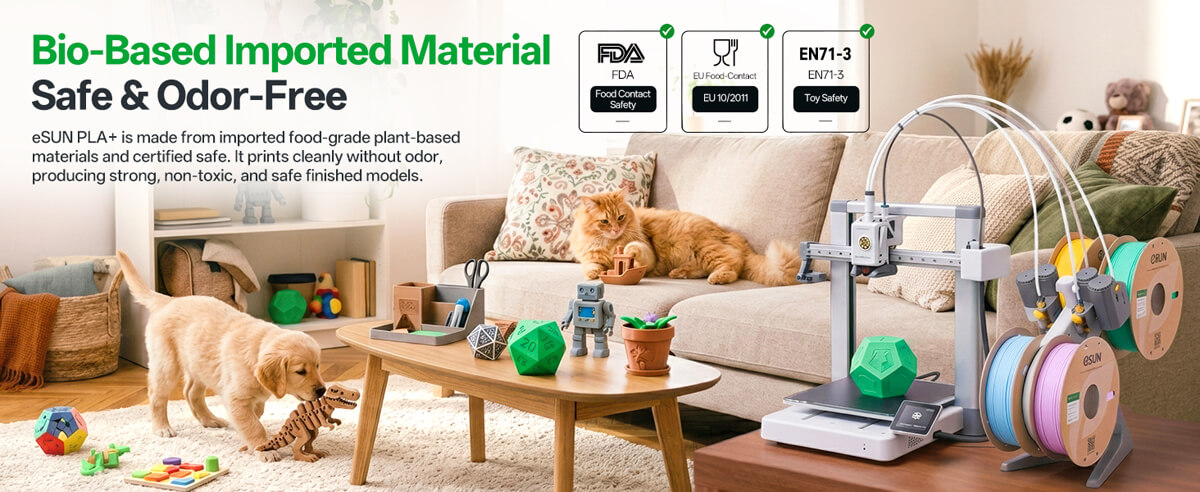
Poly(lactic acid) (PLA) is derived from renewable bio-based resources and offers significant environmental benefits, making it a promising alternative to conventional petroleum-based plastics.
Traditional PLA Limitations
Relatively brittle, limited impact resistance, low elongation at break, and insufficient interlayer adhesion, making complex applications difficult.
Legacy Mainstream (ABS) Challenges
High shrinkage and tendency to warp required demanding printing environments and equipment, limiting wider technology adoption.
How could PLA combine environmental benefits, printability, and high performance?
This became one of the key challenges driving eSUN’s continuous materials R&D. Since the company’s early days, eSUN has regarded the industrialization of PLA biomaterials as a long-term strategic direction. Through continuous research into the material value chain, performance, and market demand, eSUN shifted its focus toward high-value and differentiated applications, identifying 3D printing as a key breakthrough area.
02 | Continuous Technical Innovation: From PLA Materials to 3D Printing Filament
To address the performance limitations of PLA, eSUN has developed an R&D system covering material synthesis, modification, formulation design, process optimization, performance testing, and printing validation. The process continuously optimizes both material performance and printing processes around real-world application requirements.
Step 1
Breaking Through Basic Performance Limitations
Conducts material modification research using molecular structure optimization, modification systems, and formulation design to improve toughness and mechanical performance.
Step 2
Balancing Performance with Printability
Combines testing with real-world validation, balancing melt flow, cooling, interlayer adhesion, and printing stability to ensure a stable user experience.
Step 3
Expanding to Multifunctional Materials
Expands from standard PLA to high-toughness, high-speed, lightweight, high-temperature, engineering, and fiber-reinforced materials.
In 2007, eSUN was among the first companies globally to commercialize PLA 3D printing filament, pioneering the industrial application of PLA in 3D printing.
03 | R&D Achievements: From Technical Breakthroughs to Industry Impact
Key R&D Achievements
100+
Patent Applications Filed
90+
Patents Granted
20+
Standards Led/Participated
ISO 5425:2023
International PLA Filament Standard
In 2023, ISO 5425:2023 (Specifications for use of poly(lactic acid) based filament in additive manufacturing applications), led by eSUN, was officially published, providing an international technical framework for PLA-based 3D printing filament standardization.
Representative Technical Breakthroughs
Core-Shell Toughening Technology
In-house toughening system developed to improve overall mechanical performance. Applied to product lines including PLA+.
Lightweight Foaming Technology
Achieves up to 220% foaming ratio, reducing material density to 0.54 g/cm³ for significant weight reduction.
Rapid Crystallization Technology
Shortens semi-crystallization time of PLA for faster cooling and solidification, ideal for high-speed printing.
Chemical Recycling of PLA
Established a 5,000-ton capacity chemical recycling line in 2013, advancing full lifecycle circular utilization.
04 | From Laboratory to Real-World Applications
The ultimate goal of R&D is to translate technological innovation into practical application value across prototyping, education, creative projects, functional parts, and structural components.
Case Study 1
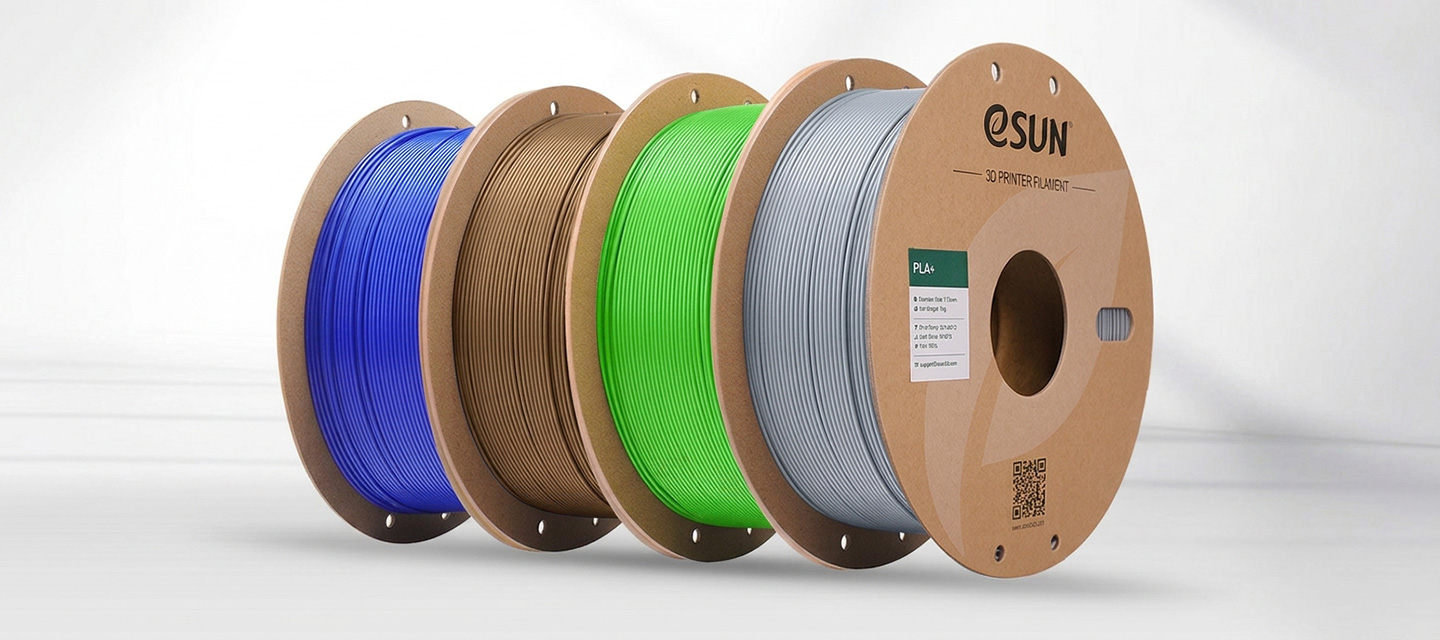
PLA+: From “Brittle” to “More Durable”
Challenge: Traditional PLA offers good rigidity but limited toughness, making it susceptible to fracture under impact or stress.
Solution: Core-shell toughening technology optimizes the PLA material system, improving toughness while maintaining printability.
Value: Moves PLA into functional printing scenarios requiring higher durability.
Case Study 2
PLA-LW: Using Less Material to Achieve Same Dimensions
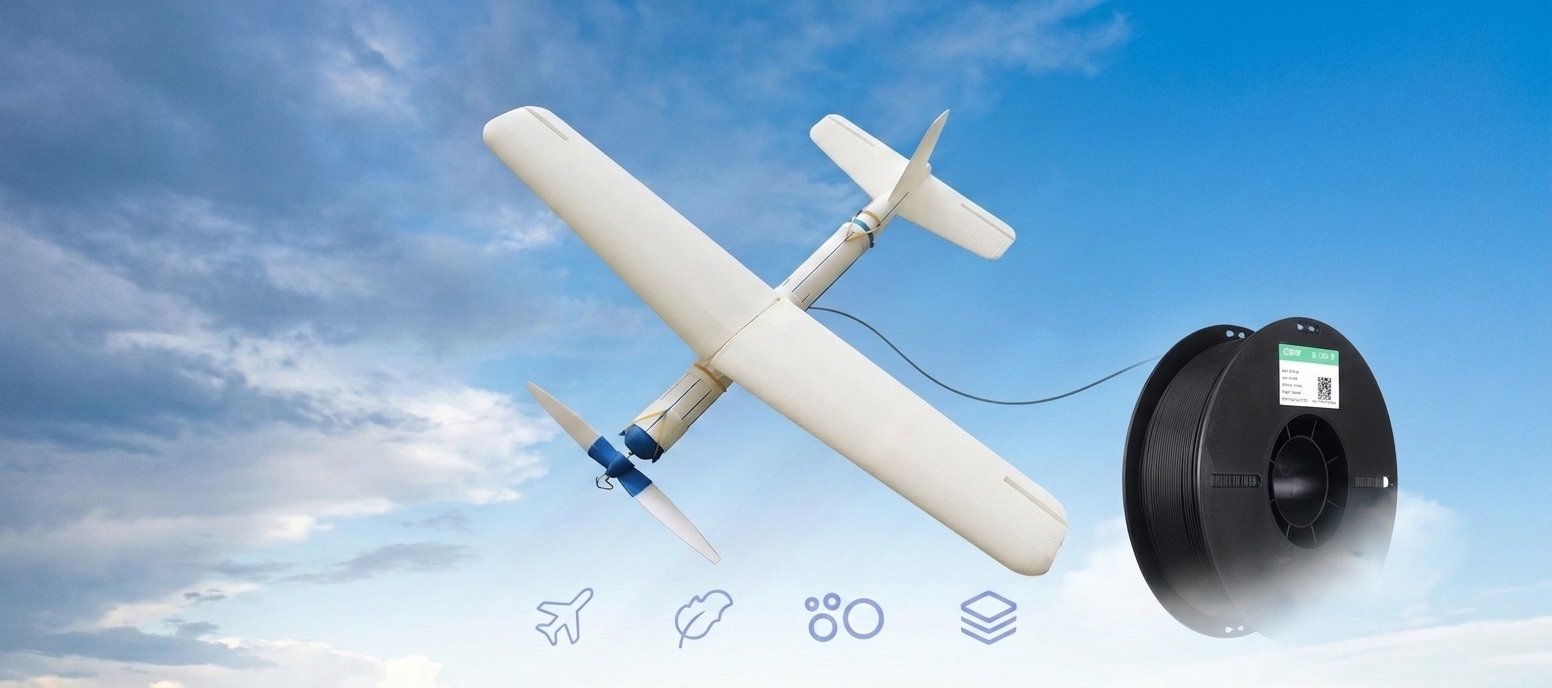
Challenge: Large models and weight-sensitive applications (drones/robotics) add excessive weight and material consumption.
Solution: Foaming technology reduces density with controlled expansion parameters.
Value: Cuts part weight while preserving full dimensions for lightweight design.
Case Study 3
PLA-HS: Supporting Next-Gen Efficient Printing
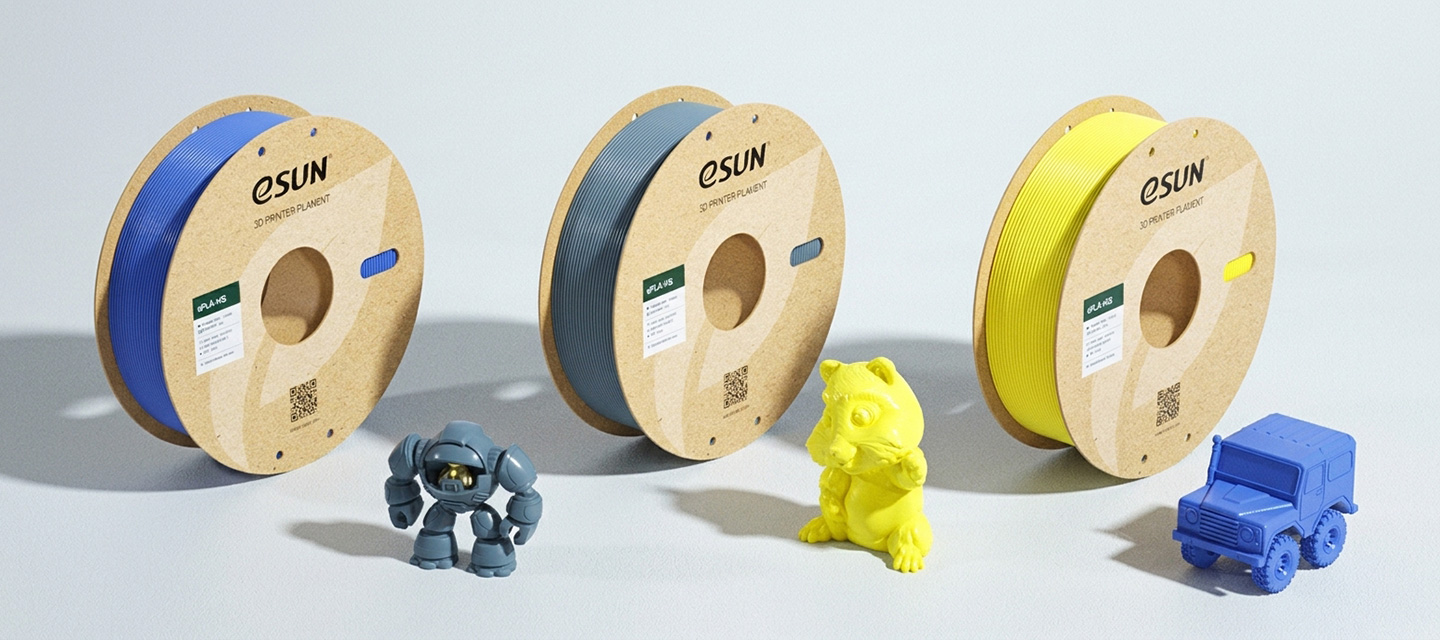
Challenge: High-speed 3D printers cause cooling, rapid solidification, and interlayer bonding issues for standard PLA.
Solution: Shortened semi-crystallization time enables rapid solidification during fast extrusion.
Value: Supports high-efficiency 3D printing without sacrificing part quality.
05 | The Future of Technology: From General-Purpose to Functional Materials
As 3D printing evolves from consumer-level creation toward industrial manufacturing, eSUN continues advancing R&D across six key future directions:
High-Speed Printing
Improving melt flow, crystallization, cooling, and rapid solidification performance.
Engineering Materials
Developing high-performance engineering materials such as PEEK and PEI.
Reinforced Composites
Expanding carbon-fiber, glass-fiber, conductive, and thermal-conductive materials.
Sustainable & Circular
Exploring bio-based, recyclable, and circular technologies across full lifecycles.
Intelligent Materials R&D
Integrating formulations, printing parameters, and AI technologies.
Emerging Technologies
Exploring next-gen technologies including SLS powders, 4D printing, and bio-synthetics.
From a Single Roll of PLA to a Complete Materials Innovation System
For more than two decades, eSUN has remained committed to continuous innovation in PLA and bio-based materials. Looking ahead, eSUN will continue placing materials innovation at the heart of its R&D strategy, bringing more high-performance, sustainable, and functional materials to 3D printing and broader industrial applications.